Ouvir esta notícia
Gere o áudio e ouça enquanto navega
Jupiter’s New Measurements: Flatter, Squashed, Still the Biggest Boy
Resumo por IA TL;DR
"Textbooks will need to be updated.".
For astronomers, technological advances are akin to getting better glasses—there’s often a big jump in resolution. It can make the world considerably clearer and, in the case of astronomy, expose some misconceptions we’ve held about the cosmos.
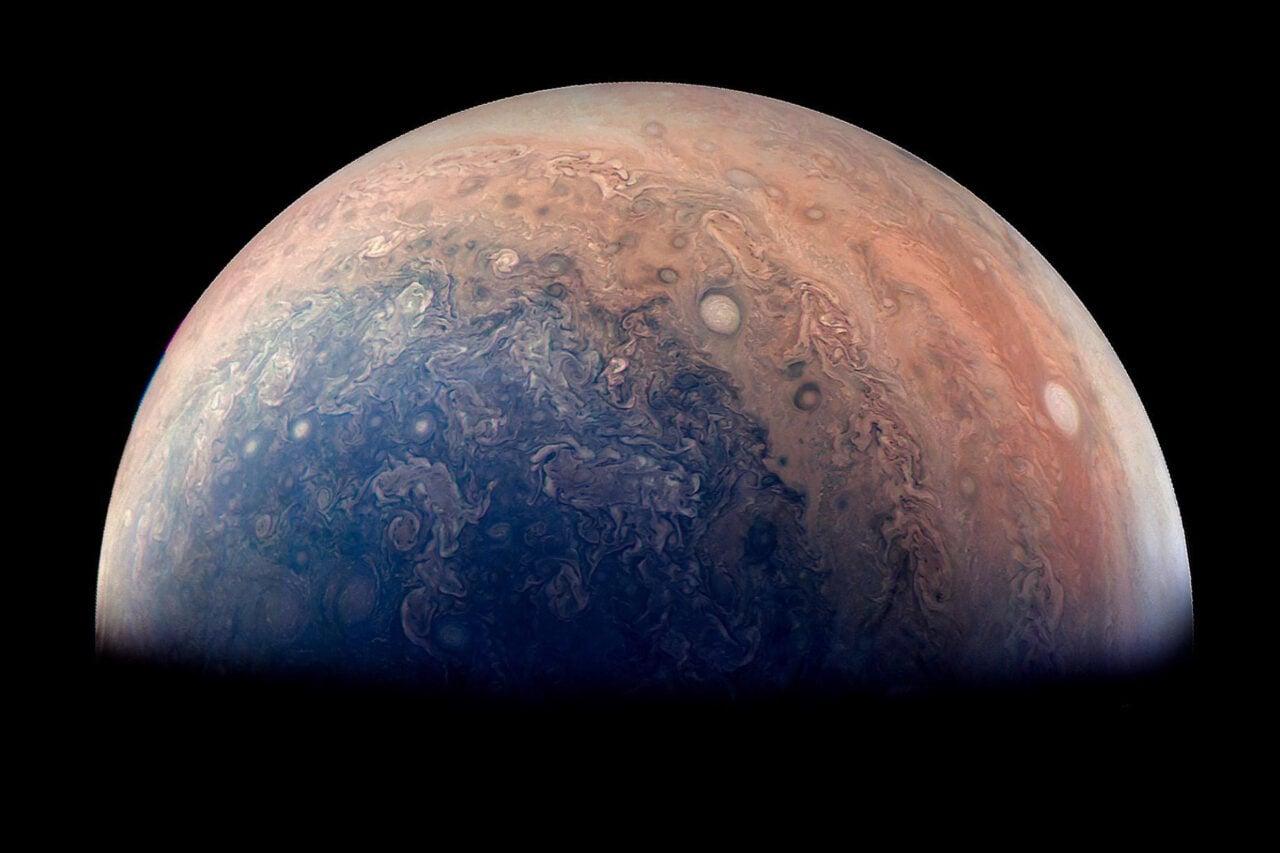
To be clear, Jupiter is fine. The giant planet itself likely hasn’t changed all that much in the past 50 years, ever since NASA’s Pioneer and Voyager probes flew past and made their measurements. But newer, clearer data collected by the Juno spacecraft suggest that the half-century-old consensus on Jupiter’s size was a slight overestimate. According to a Nature Astronomy study published yesterday, Jupiter is actually flatter at the poles and slimmer at the equator than was previously believed.
“Textbooks will need to be updated,” mused Yohai Kaspi, the study’s senior author and an astronomer at the Weizmann Institute of Science in Israel, in a statement. “The size of Jupiter hasn’t changed, of course, but the way we measure it has.”
Pioneer 10’s historical flyby took place in late 1973. Voyager 1 and 2 followed its trails around six years later. It was during these missions that humanity got its first-ever measurements of Jupiter: an analysis of the gas giant’s shapes, based on six radio profiles.
According to this early data, Jupiter’s equatorial radius was around 44,423 miles (71,492 kilometers), and its polar radius was about 41,541 miles (66,854 km), with an approximate range of uncertainty between 2.8 and 6.2 miles (4 and 10 km). (Planets are not perfect spheres and are better described as oblate spheroids.)
These estimates ruled the astronomical consensus for years, although scientists knew it wasn’t perfect. For one, they were based on a small handful of measurement passes and didn’t account for the powerful winds known to shape Jupiter’s atmosphere.
Then in 2016, Juno started making its rounds around Jupiter, capturing and sending back new data. What’s more, NASA’s 2021 extension of the mission sent the spacecraft into an orbit that took it behind Jupiter from Earth’s point of view—putting it in a perfect position to collect detailed information about the planet’s size, according to the researchers.
“When the spacecraft passes behind the planet, its radio communication signal is blocked and bent by Jupiter’s atmosphere,” explained Scott J. Bolton, study co-author and Juno’s principal investigator, in the release.
The team behind the new study developed a special technique to translate this bent signal into “detailed maps of Jupiter’s temperature and atmosphere,” added Maria Smirnova, study co-author and a PhD student at Weizmann. They also made sure to account for Jupiter’s stormy weather, which a previous study led by Kaspi had clarified.
Compared to the previous estimates, Jupiter is about 5 miles (8 kilometers) slimmer at the equator and 15 miles (24 kilometers) flatter at the poles. Jupiter’s equatorial radius is approximately 7% greater than its polar radius. By “flatter,” scientists mean that Jupiter has a more squashed shape at the poles and a stretched-out equator compared to a perfect sphere. By comparison, Earth’s equatorial radius is roughly 0.33% greater than its polar radius—meaning Jupiter is about 20 times flatter than Earth.
Considering the sheer size of Jupiter (and, for that matter, any cosmic body), the new measurements might not seem like that much of a change. But “these few kilometers matter,” according to Eli Galanti, study lead author and a Weizmann staff scientist.
To be exact, the slight shifts in the planet’s known radius translate to huge improvements in how scientific models of Jupiter’s interior align with measurements of gravity and atmospheric dynamics, Galanti explained.
Given how Jupiter serves as a “standard reference” for the study of gas giants, the new findings may have significant implications for studying similar entities within the solar system and beyond, the researchers added.